

Material innovation for contemporary interiors
Surfaces designed beyond the worktop
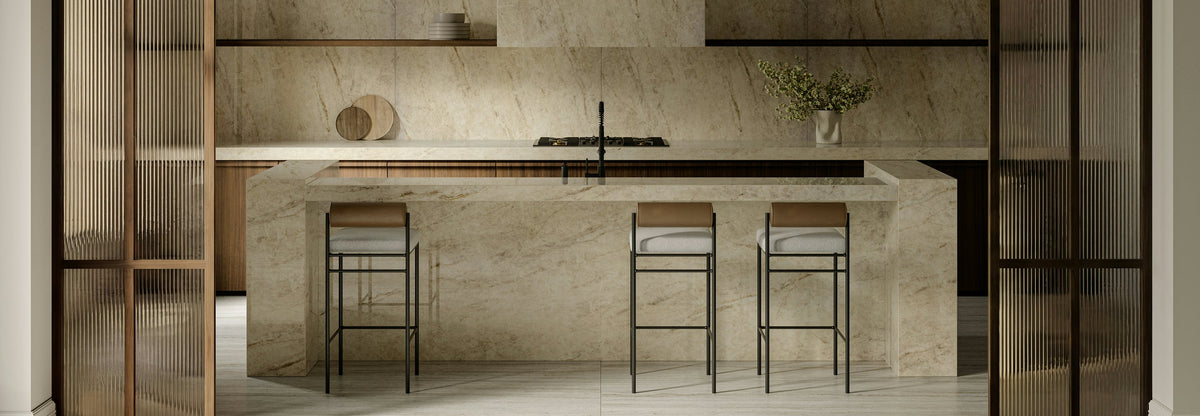
Cosentino develops architectural surfaces in which material technology, colour and design are considered together. At Bødker &, we work with two distinct Cosentino material worlds: Dekton, an ultracompact surface created for demanding applications, and Eclos, a layered mineral surface developed for interior architecture.
Kitchen worktops are the application we discuss most often, but the possibilities extend considerably further. Depending on the selected material and its technical suitability, Cosentino surfaces can be used for wall and furniture cladding, tiles, shelving, tables and other bespoke interior elements. This allows the material language to continue beyond the worktop and become part of the wider architecture of the room.
In a Buster + Punch kitchen, the surface is considered in relation to the cabinetry, freestanding steel frame and hardware, as well as Blanco sinks and integrated Fisher & Paykel appliances. Each element is specified as part of one coherent composition rather than selected in isolation.
Dekton
An ultracompact surface for demanding applications
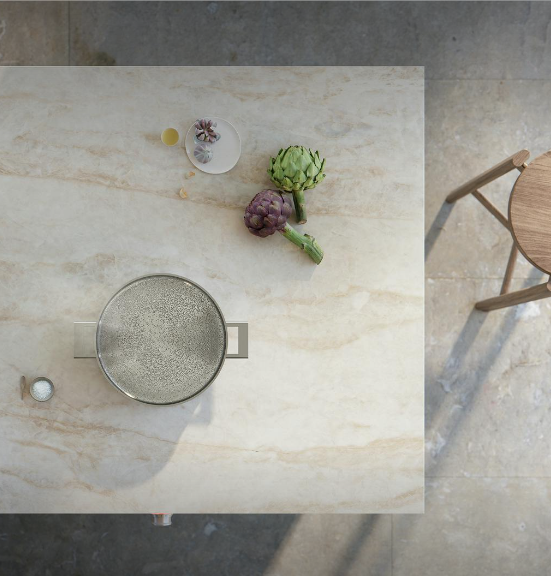
Dekton by Cosentino is an ultracompact surface that combines a refined material expression with the technical qualities required for demanding kitchen and interior applications. Its extensive palette ranges from quiet, tonal designs to surfaces with pronounced veining, mineral depth and architectural contrast.
In a Buster + Punch kitchen, Dekton can be specified as a precise counterpoint to the cabinet finish, steel frame and hardware – or selected to create a more continuous, tonal composition. Different colours and patterns can reinforce the warmth of brass and smoked bronze, introduce contrast against black hardware or complement the cooler character of steel and gun metal.
The worktop is planned around the functions of the kitchen from the outset. Cut-outs and details can be specified for Blanco sinks, taps and integrated Fisher & Paykel appliances, allowing practical elements such as induction cooking and downdraft ventilation to become part of the overall architecture.
Eclos
A layered mineral surface for interior architecture
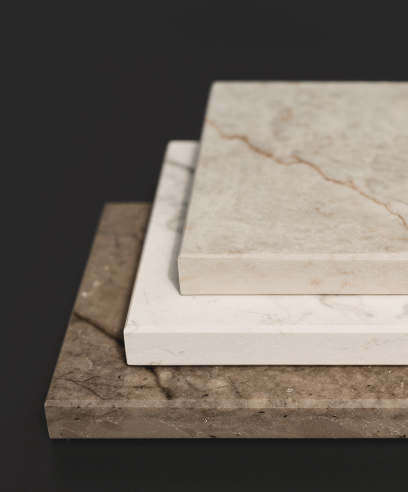
Eclos introduces a different material expression within the Cosentino universe. Developed for interior architecture, the mineral surface is created using Cosentino’s INLAYR® technology, which integrates colour, movement and veining into the material through a layered design process.
This three-dimensional coherence gives the surface visual depth and allows its character to continue through visible edges and carefully considered profiles. Eclos is therefore particularly compelling on freestanding Buster + Punch kitchen islands, where the worktop is experienced from several angles as part of a complete furniture composition.
The ten designs in the first Eclectic Veins collection range from quiet, luminous tones to deeper and more expressive mineral compositions. Selected alongside the cabinet finish, steel frame and Buster + Punch hardware, each surface can create either subtle tonal continuity or a deliberate contrast between materials.
From Macael to international design
A family business shaped by material, place and innovation
Cosentino’s story begins in Macael in southern Spain, a region shaped by generations of natural stone extraction and craftsmanship. In 1945, Eduardo Cosentino and Eduarda Justo established a small family workshop dedicated to processing marble – the foundation of the international surface company that Cosentino has since become.
This close relationship with material and place remains part of the company’s identity. Over successive generations, traditional knowledge of stone has been combined with industrial development, research and design, expanding the possibilities of architectural surfaces far beyond the original marble workshop.
Today, Cosentino develops materials for kitchens, bathrooms, furniture, interior architecture and other built environments around the world. Dekton and Eclos represent different stages in this continuing development, each combining material character with technology and contemporary design.

Innovation with responsibility
A continued focus on energy, water and circular resources
Material innovation also brings a responsibility to consider how surfaces are produced. Cosentino’s environmental strategy includes the use of certified renewable electricity, water recirculation, self-generated solar energy and the recovery of waste and raw materials within its production processes.
At its industrial park in Cantoria, Cosentino reports that 100% of the electricity used is certified from renewable sources and that 99% of the water employed in its production processes is recycled. Its extensive photovoltaic installation contributes additional renewable energy for on-site consumption, while the company’s own waste treatment and recovery facilities support the continued development of a more circular production model.
These initiatives do not make every surface or application identical in its environmental profile. They do, however, demonstrate an ongoing effort to reduce resource consumption, recover materials and document environmental progress across Cosentino’s operations. When specifying a surface, we therefore consider both its visual and technical suitability and the available documentation for the particular material.
Designed as one composition
Surfaces, cabinetry, hardware and appliances considered together
A kitchen surface is never selected in isolation. Its colour, movement, finish, thickness and edge profile influence the way the cabinetry, steel structure and hardware are experienced – while the positioning of sinks, taps, cooktops and ventilation determines how the kitchen functions.
At Bødker &, Cosentino surfaces are specified as part of a complete Buster + Punch kitchen. Dekton or Eclos is considered alongside the cabinet finish, freestanding steel frame and Buster + Punch hardware, together with Blanco sinks and integrated Fisher & Paykel appliances from the earliest stages of the design process.
This integrated approach allows cut-outs, visible edges, joints and appliance openings to become part of the architecture rather than details resolved at the end. In selected projects, the surface can also extend beyond the worktop into furniture, cladding, shelving or other bespoke elements, creating continuity across the wider interior.
The result is a composition in which materials, functions and details share the same visual language.
Consultation
Specify the right surface for your project
Choosing a surface is both a visual and a practical decision. Samples provide an important first impression, but the scale, movement and edge character of a full slab should also be considered – particularly when working with expressive veining or larger, uninterrupted surfaces.
We advise on the complete specification, from the choice between Dekton and Eclos to colours, finishes, dimensions, edge profiles, cut-outs and integration with the Buster + Punch kitchen, Blanco sinks and Fisher & Paykel appliances.
Visit our showroom or book an online meeting to explore the materials and discuss how Cosentino surfaces can become part of your kitchen or interior project.